
Kleberg County Court Records After a Jail Arrest
The arrest-to-court path in Kleberg County runs through two related record systems. The Kleberg County Detention Center, operated by the Kleberg County Sheriff's Office, creates the booking record after an arrest and intake at the jail. That detention record can show the arresting agency, booking date and time, charge text, and bond amount. A formal court record is different. It is created through the prosecutor, clerk, and court when a complaint, information, indictment, order, setting, or disposition is filed.
The jail roster may be the first place a name appears after an arrest, but it is not the last word on prosecution. For the custody side, use Kleberg County jail inmate records to check the roster, booking number, arresting agency, and bond field. For booking photographs and roster profile images, use Kleberg County jail mugshots. Court records after a jail arrest should be checked separately through re:SearchTX, the Kleberg County District Clerk, or the Kleberg County Clerk, depending on the court and case level.
How to Find Kleberg County Court Records After an Arrest
Start with the booking information, then search the court side. The official sheriff roster can help identify the booking event, but the court case may not be available at the exact same moment the person appears in jail. New arrests can require magistration, prosecutor review, clerk filing, or grand jury action before the court record is visible in a public index.
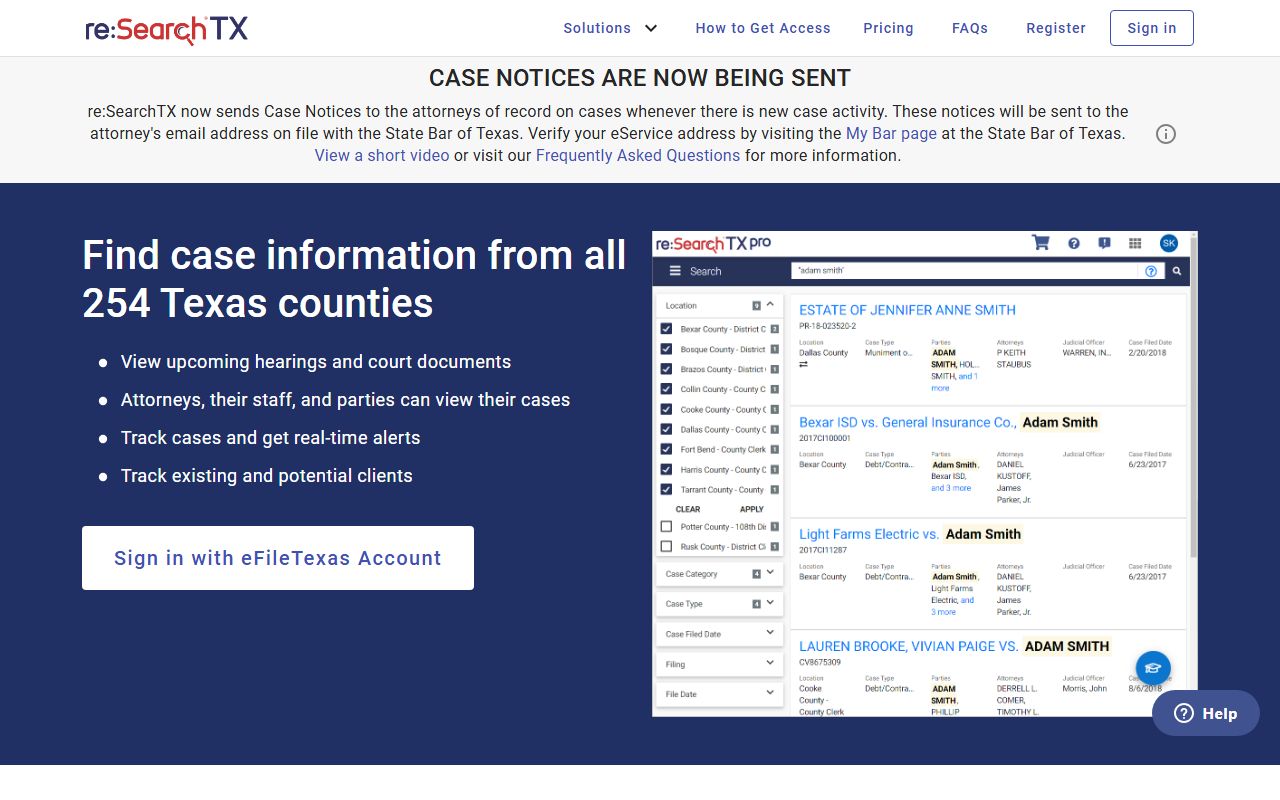
The re:SearchTX public court-record portal is the statewide judicial branch channel to try for name, case, and court searches. Access and document visibility may depend on registration, court participation, and document-level restrictions. Local clerk channels remain important because felony and district matters generally route through the District Clerk, while county-level misdemeanor records may involve the County Clerk.
The re:SearchTX court-record portal is shown in the local screenshot captured from the Texas judicial branch search page.
- Open the jail roster first and write down the public booking details: name, booking number, arresting agency, booking date, charge text, and bond amount if displayed.
- Search re:SearchTX by party name, case or cause number, court or county filter, and date filters when available.
- Check the Kleberg County District Clerk for district-court criminal matters and the Kleberg County Clerk for county-level records.
- If a portal result does not match the booking charge, compare the filed charge, court, cause number, and date before assuming it is the same case.
Search fields commonly include party or defendant name text, case or cause number, county and court filters, and date ranges. A cause number from bond paperwork, court paperwork, or a clerk response is stronger than a broad name search, especially when a common name produces multiple results.
How Charges Get Filed After an Arrest: Complaint, Information, and Indictment
Booking happens at the jail. Formal prosecution begins when a charging document or court filing states what criminal accusation will be pursued. In Kleberg County, felony and district matters are associated with the Kleberg County District Attorney and District Clerk channels. County-level matters may involve the Kleberg County Attorney and County Clerk channels, depending on the type of case. Municipal Class C cases or city warrants may be handled in a municipal court rather than in the county or district clerk index.
| Document | Who Uses It | What It Does | Why It May Differ From Booking |
|---|---|---|---|
| Complaint | Officer, prosecutor, or complainant process | States an accusation under oath or begins an early criminal proceeding. | The first complaint can be replaced or refined after prosecutor review. |
| Information | Prosecutor | Files a formal charge without a grand-jury indictment where Texas procedure allows it. | The prosecutor may choose different wording, a different level, or a reduced charge. |
| Indictment | Grand jury | Charges a felony or serious matter after grand-jury presentation. | An indictment may add, enhance, reject, or reshape the original booking allegation. |
Charge Status in Court Records After an Arrest
A roster charge is detention data. A filed charge is court data. The two may match, but they can also diverge as prosecutors review police reports, evidence, witness statements, prior history, jurisdiction, and legal elements. A charge can be amended, reduced, enhanced, dismissed, rejected before filing, or presented to a grand jury. Court records after an arrest should therefore be read by status and date, not just by the first charge label visible in the jail roster.
| Status | What It Means | Practical Reading |
|---|---|---|
| Pending | The charge or case is open and unresolved. | Check the next setting, bond conditions, and whether more charges have been added. |
| Amended or Reduced | The formal filed charge changed from an earlier allegation. | Do not treat the booking charge as the final prosecution charge. |
| Dismissed | The court record shows the charge or case ended without that charge producing a conviction. | Check whether other counts remain pending or whether expunction may be case-specific. |
| Presented to Grand Jury | A felony matter may be reviewed for indictment. | The filed case can become broader, narrower, or different after grand-jury action. |
| Disposed | The court has entered an outcome such as plea, verdict, dismissal, or other final action. | Read the disposition details before describing the result. |
Bond and Release After an Arrest
The Kleberg sheriff roster sample showed a bond field with a dollar amount, but the official sheriff page for posting bond was marked temporarily suspended when researched. That means the roster may show a public bond amount while the local payment instructions, accepted methods, and posting location still need live verification. Call the Kleberg County Detention Center at 361-595-8500 before attempting to post bond, especially if the person has a detainer, out-of-county hold, parole hold, federal hold, ICE issue, or no-bond order.
Texas bail and release decisions are governed by Texas Code of Criminal Procedure Chapter 17. Bond information shown on a jail record is not the same as a full court docket entry. A court may impose conditions, change the amount, address separate counts, or enter an order that does not appear in the public roster profile.
| Bond Type | How It Works |
|---|---|
| Cash Bond | The full bond amount is deposited as security for appearance, subject to court and local payment rules. |
| Surety Bond | A Texas-licensed bondsman posts the bond after fee, collateral, and jail or court acceptance requirements are addressed. |
| Personal Bond or PR | Release occurs on written promise and court conditions without depositing the full cash amount. |
| No-Bond Hold | Release cannot be completed by paying money alone because of a hold, court order, serious charge, parole matter, or another agency. |
Warrants That Lead to an Arrest
No full searchable Kleberg County Sheriff active-warrant database was located in the official sources reviewed. The sheriff navigation includes a Most Wanted path, but a Most Wanted page is not the same as a complete warrant database. Bench warrants, arrest warrants, capiases, municipal warrants, parole warrants, and out-of-county holds may live in different systems.
For a warrant-related booking, check the jail roster after service of the warrant, then use the relevant clerk or court to confirm the source of the warrant. Call 361-595-8500 for jail or sheriff warrant-related questions. For county and district cases, use the District Clerk or County Clerk official pages. For city Class C, traffic, or code matters, check the issuing municipal court. Public-information requests can be used when a specific warrant or booking record is not available online, but urgent warrant resolution should be handled through the issuing court, sheriff, or legal counsel.
Charges vs. Convictions
An arrest and a filed charge are accusations, not proof of guilt. A conviction requires a plea, verdict, or other court outcome that legally establishes guilt for a charge. Many public misunderstandings come from treating jail roster data as a conviction record. Court records after a jail arrest should be read all the way to disposition before using the information to describe a final outcome.
| Charge | Conviction | |
|---|---|---|
| Stage | Accusation at booking or filing. | Final or qualifying court outcome after plea, verdict, or judgment. |
| Proof Level | Based on arrest, probable cause, prosecutor review, or grand-jury action. | Requires the criminal standard and a formal court result. |
| Where Seen | Jail roster, complaint, information, indictment, docket, or clerk record. | Judgment, plea, verdict, disposition, sentence, or state criminal-history record. |
| Can Change | Yes, charges can be amended, reduced, enhanced, dismissed, or rejected. | Yes, but through court action, appeal, post-conviction relief, or record-clearing process. |
Sealed vs. Expunged Arrest Records
Texas record-clearing rules are specific to the case result and the record type. Texas Code of Criminal Procedure Chapter 55 governs expunction of certain qualifying criminal records. A dismissed charge, rejected case, acquittal, or other favorable outcome does not automatically erase every public trace at the moment the court acts. A person generally needs a qualifying legal process and signed order before agencies change or remove records.
| Sealed or Nondisclosed | Expunged | |
|---|---|---|
| Public View | Hidden from most public access if an order applies. | Removed, destroyed, or treated under Texas law as if it did not exist for many purposes. |
| Agency Access | Some criminal justice or authorized users may still have limited access. | Access is much more restricted and controlled by the expunction order. |
| Typical Basis | Depends on Texas nondisclosure eligibility and case disposition. | Depends on Chapter 55 eligibility such as certain acquittals, dismissals, no charges filed, or other qualifying outcomes. |
| Local Action | Provide the order to the clerk or agency if a public record still appears. | Use the signed expunction order to address remaining court, jail, or criminal-history records. |
Background Check Considerations
Casual court-record lookup is not the same as an FCRA-compliant background check. Public records can be incomplete, delayed, restricted, or mismatched by name. Texas Code of Criminal Procedure Chapter 66 governs criminal-history reporting structure, while the public availability of local records runs through the Texas Public Information Act and the applicable court or agency rules.
Important: Kleberg County inmate and court lookup information is not a consumer report and must not be used for FCRA-covered decisions.
Restricted Court Records After an Arrest in Kleberg County
Public access in Texas begins with Texas Government Code Chapter 552, the Public Information Act, but exceptions and confidentiality rules matter. Government Code 552.108 may apply to certain law-enforcement and prosecution information, especially in active matters. Juvenile records, sealed records, expunged records, confidential victim information, medical or classification details, and pending investigative materials may be withheld or limited. If a record is missing from a public portal, the reason may be timing, court participation, confidentiality, a different court, a different cause number, or a record-clearing order.